

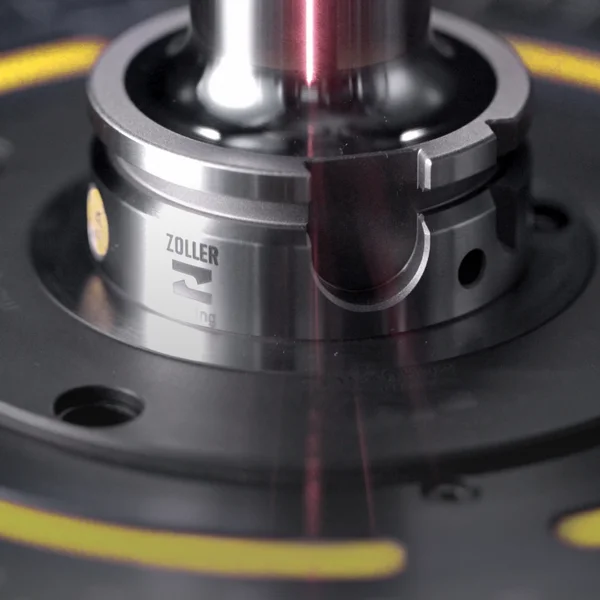
What are the consequences of the imbalance in the tool?
Tools that run unevenly cannot be used with the same precision that you need for your work over the long term. The vibrations that occur not only reduce the overall cutting performance, they also create artifacts on the workpieces, such as chatter marks, which may have to be reworked. Imbalances in the tool therefore lead to very specific quality losses and jeopardize the process reliability of your processes.
In addition, imbalances also reduce the service life of the spindle and possibly the machine - the costs for this quickly exceed the expenses incurred by frequent balancing of the tools.
What does unbalance mean?
The term "unbalance" is used to describe the ubiquitous phenomenon in rotating bodies that their mass is not distributed over the body in a rotationally symmetrical manner. There are three main types of unbalance:
- Static unbalance: Here, the center of gravity of the rotating body lies outside the axis of rotation. This can already be measured at standstill.
- Torque unbalance: The center of gravity is on the axis of rotation; the unbalance only becomes measurable during the rotary motion.
- Dynamic unbalance: The term dynamic unbalance combines the two other forms of unbalance, in any combination of static unbalance and torque unbalance. This is the rule for technical rotors.
Each specific form of unbalance can be corrected by making appropriate adjustments to the rotating body.
During rotation, the greater the unbalance (linear growth) and the faster the rotational movement (quadratic growth), the more noticeable the unbalance becomes. The faster the rotational movement, the more important balancing becomes and the more important it is to reduce the residual unbalance as much as possible. Balancing should therefore be systematically integrated into the work process.
What causes imbalances in tool operation?
Imbalances are a well-known and regularly occurring phenomenon in rotating tool systems. There are various possible causes, for example:
- A tool consisting of several individual parts was not assembled correctly - for example, if the tool holder and the tool are not exactly aligned and deviate from the axis of rotation.
- The mass distribution of the tool was already asymmetrical during production - the manufacturer's production tolerances must be observed and checked if necessary.
- The rotor itself or the tool holder is asymmetrical due to its design (e.g. clamping screw in a milling adapter (Weldon holder)).
Even with finely balanced tool holders, an imbalance can occur again due to the combination of the holders with the specific tool. It is very important to measure this and correct it if necessary.
Why is balancing tools so important?
In the high-speed machining of workpieces with rotating tool systems, any small inaccuracy, any lack of precision, can become noticeable very quickly and very clearly. An imbalance in the tool can cause vibrations, but certainly unsteady running.
Both affect the accuracy with which the tool works and always increase the risk of artifacts and damage to the workpiece: The surface quality is reduced and rejects can occur. However, as your processes are heavily dependent on correctly machined end results, tools that are not precision-balanced require more detailed quality checks. Reworking may also be necessary; in any case, process reliability is not guaranteed.
Missing balancing costs money
This can result in delays in the production process, which in turn have a direct impact on your ability to deliver the ordered quantity on time and in the required quality.
Added to this is the fact that unevenly running tools can reduce the service life of the lathe spindle, particularly due to vibrations - another cost factor that should not be underestimated.
Balanced tools are therefore good for the workpieces and for the machines.
Rule of thumb: Often balanced, rarely regretted!
The rule of thumb is therefore: It is better to balance the tool in good time and more frequently than to end up bearing the costs. In general, a tool should be rebalanced as soon as it is used at a different speed - because even this change can cause significant differences in running smoothness.
Regular balancing increases productivity and the quality of your work.
Balancing tools: How does it work?
In general, there are three ways to correct or eliminate an imbalance:
- Add mass (e.g. with additional weights)
- Remove mass (e.g. by drilling or grinding)
- Adjust the mass (e.g. using suitable rotating rings)
To make the process easier and more precise, especially for tools, the use of a balancing machine with suitable software is recommended. Here, the tool is first inserted into a balancing spindle and set in rotation in order to measure the centrifugal forces that occur.
Automatically calculated unbalance correction
The balancing system then uses this measurement data to calculate the unbalance correction. With an advanced balancing machine, the measures can then be implemented immediately and fine balancing continues until no more residual unbalance can be measured or all values are within an acceptable tolerance range.
In this way, balancing does not even take particularly long and the unevenly distributed mass can be corrected quickly.
A highly accurate and largely automatic balancing system also makes sense because it enables tools to be balanced again quickly with every changeover. This prevents quality losses due to changes in requirements, speeds or materials without compromising the speed of the work.
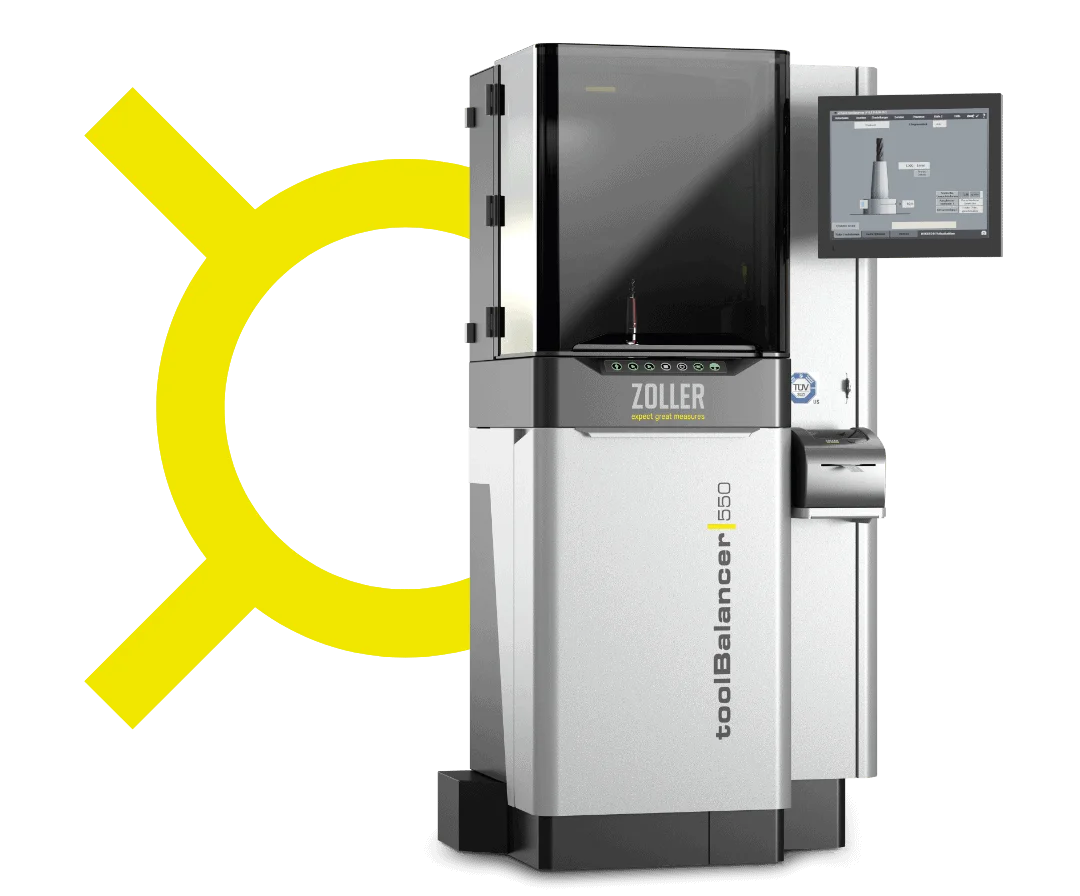
Efficient balancing with the ZOLLER »toolBalancer«
Finely balanced tools, even for work with high rotational speeds: The ZOLLER »toolBalancer« is the perfect balancing system for this. With its modular design, it can not only be individually adapted to your very specific requirements, but also has plenty of scope for future developments.
The high-precision balancing system is suitable for tool holders, grinding wheels and rotors, and guarantees you measurably lower reject rates, machine downtimes, production costs and delivery times.
The advantages at a glance:
- Less wear and more cutting performance thanks to high-precision balanced tools
- The modular design allows individual adaptations
- The self-explanatory operation of the system avoids unnecessary and costly errors
- Convenient use with touchscreen, keyboard and mouse
Learn all about the possibilities of the ZOLLER »toolBalancer«

Select language
Europe